We've written about the sunrise, the facts, and the day plan — this guide is about the building. Most visitors spend two hours inside Angkor Wat and see it in the wrong order, missing half of what makes it the greatest religious monument on Earth. Here's how the temple is organized, what to look at, and the route that makes it legible.
How Angkor Wat Is Organized (60 Seconds)
Think of it as three rectangles inside each other, rising as they go in: the outer gallery (the bas-reliefs), the second level (quieter courtyards and a thousand Buddhas' worth of history), and the Bakan — the steep central sanctuary with its five towers. The whole thing models Hindu cosmology: the moat is the cosmic ocean, the walls are the mountain ranges at the world's edge, and the towers are Mount Meru, home of the gods. You're not walking into a building; you're walking a map of the universe toward its center.
The Route That Works
1. Cross the causeway like it matters
The western causeway over the moat is the longest architectural approach shot in the ancient world. Walk the left (north) edge for the classic angles, and pause at the naga balustrades — you're crossing the cosmic ocean on a rainbow serpent bridge. That's the intended reading, and it beats hurrying.
2. Walk the bas-reliefs first — counter-clockwise question
The outer gallery holds nearly a kilometer of carved storytelling, and almost everyone either skips it or samples thirty seconds. The essential panels: the Battle of Kurukshetra (west gallery — the Mahabharata's great war), the Historic Procession of Suryavarman II (south — the king who built this, on parade with his army), Heavens and Hells (south — 12th-century judgment, inventive punishments included), and the masterpiece, the Churning of the Sea of Milk (east gallery — 49 meters of gods and demons churning creation itself, the myth the whole city riffs on). Give the reliefs 45–60 minutes; it's the highest-density hour at Angkor. A guide earns their fee in this gallery more than anywhere else in the park.
3. The second level: breathe
Cooler, dimmer, quieter. Look for the walls once covered by the "hall of a thousand Buddhas" (many images survive in fragments), the echo chambers, and centuries of pilgrim graffiti — the temple has been in continuous use since it was built, and this floor is where you feel it.
4. The Bakan: climb it (rules apply)
The upper sanctuary opens after early morning, runs a strict dress check (shoulders and knees — the enforced kind), caps entry with a queue at busy hours, and is closed to under-12s and on certain holy days. The climb is steep by design — you were meant to arrive at the gods' level breathless. From the top: the causeway you crossed, the forest hiding the rest of the empire, and, on a clear day, the balloon and Phnom Bakheng. Fifteen minutes up there recalibrates everything you saw below.
Timing the Building (Not Just the Sunrise)
The temple faces west — so morning light silhouettes it, late-afternoon light bathes it. The wisdom is: dawn for the sky show, then breakfast, then the interior from 7:30–9:30 while the crowd thins; or the contrarian's slot, 3:30pm onward, when tour groups drain toward the sunset hills and the west face goes gold. Midday belongs to nobody; the stone is a griddle and the light is flat.
Mistakes That Waste a Visit
- Doing it exhausted, last. Angkor Wat rewards fresh legs and attention — schedule it first, not as the day's tenth temple.
- Skipping the reliefs to queue for the Bakan. Reverse it; queue lengths drop while you're reading the galleries.
- The dress-code gamble — turned away at the Bakan stairs after the queue is the classic self-inflicted wound.
- No water, no hat — the courtyards are shadeless; the packing list is short and non-negotiable.
- Treating it as done after one pass. Your pass allows re-entry — the same temple at dawn and at 4pm is two different buildings.
Guided vs Solo, One Last Time
For this temple specifically, the guide case is strongest: the reliefs are a library, the cosmology is invisible without narration, and the routing above is exactly what the flagship small-group day executes with the stories attached:
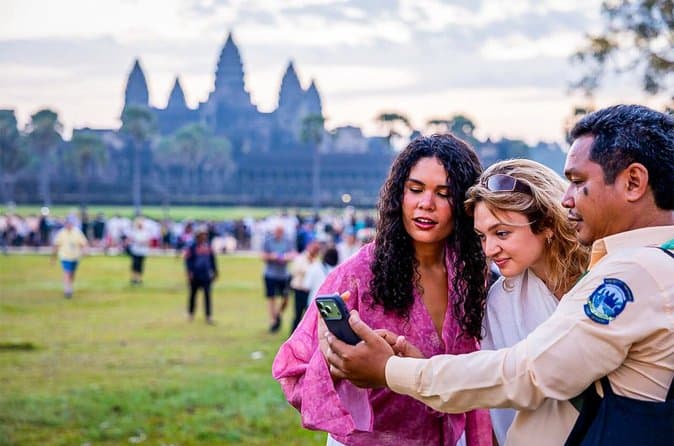
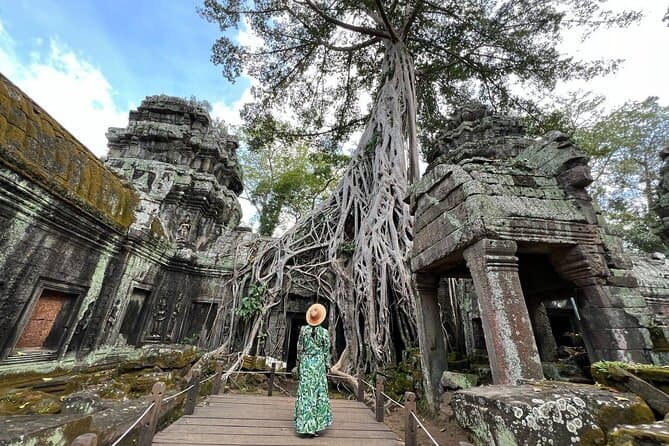
Want the sunrise handled with breakfast built in, then the temple at the thinned-out hour? That's this format's whole design:
Going alone? Take this guide on your phone, walk the order above, and let the building do the talking. Quick-reference lives on the Angkor Wat listing; the rest of the must-see set awaits when you're done with the universe's center.