Most Angkor Wat facts lists recycle the same trivia. This one is built for travelers: fifteen things that are true, checkable, and — more to the point — change what you notice when you're actually standing on the causeway at dawn.
The Big Ones
1. It's the largest religious monument in the world
The complex covers roughly 160 hectares — moat included, an area bigger than Vatican City. No cathedral, mosque, or temple anywhere exceeds it. And it's one monument inside a 400 km² park of hundreds; the scale of the whole enterprise is the first thing that breaks visitors' brains.
2. It was built in roughly three decades — in the 12th century
King Suryavarman II began it around 1113–1116 as his state temple and mausoleum, and the main structure went up within about 30 years. For comparison, many great European cathedrals took centuries. Inscriptions and estimates point to tens of thousands of workers, plus elephants as the heavy machinery.
3. It was dedicated to Vishnu — a break with tradition
Nearly every earlier Khmer state temple honored Shiva. Angkor Wat's dedication to Vishnu, the preserver, was a deliberate departure — and one key to its most famous oddity, which is next.
4. It faces west, and scholars still argue about why
Almost all Khmer temples face east, toward the rising sun. Angkor Wat faces west — the direction of Vishnu, and also of death. The leading theories: it's Vishnu's cardinal direction, and/or the temple doubled as Suryavarman II's funerary monument. Practical consequence for you: it's the world's greatest sunrise silhouette (sun rising behind it) and glows head-on in the late afternoon — the logic behind our sunrise guide's whole strategy.
5. On the equinoxes, the sun rises directly over the central tower
Stand on the western causeway at dawn around the March or September equinox and the sun climbs precisely up the silhouette of the central tower — the temple is, among everything else, an astronomical instrument. Locals and photographers plan for it; if your trip lands near an equinox, so should you.
The Myth-Busters
6. It was never "lost" and never "discovered"
The romantic tale of Henri Mouhot hacking through jungle to find a forgotten city in 1860 is a colonial myth. Angkor Wat was never abandoned — Buddhist monks maintained it continuously, Khmer people always knew it, and 16th-century Portuguese and Spanish visitors wrote about it. Mouhot's journals popularized it in Europe; that's all. There's an active pagoda within the grounds today.
7. It's Hindu-born but has been Buddhist for centuries
Built Hindu, the temple transitioned to Theravada Buddhist use around the 14th–16th centuries as Cambodia itself did — which is why you'll find saffron-robed monks and working shrines inside a temple carved with Vishnu's mythology. It may be the world's longest continuously used major religious site to switch religions without missing a beat.
8. The name is newer than the building
Angkor Wat means roughly "Temple City" or "City of Temples" — Angkor from the Sanskrit nagara (city), Wat the Khmer word for temple/monastery. It's the later, Buddhist-era name; the temple's original dedication name is lost to history.
The Engineering
9. The stones came from a mountain 50 km away
The sandstone — millions of blocks — was quarried at Phnom Kulen and moved to the site via a network of canals and rivers. The quarries and transport canals have been mapped by archaeologists. That sacred mountain is a day trip you can take; you'll be swimming below the cliffs the temple came from.
10. The moat is doing structural engineering, not decoration
The moat — about 190 meters wide, more than 5 km around — stabilizes the groundwater under the temple year-round, which is a big part of why Angkor Wat still stands nearly level after 900 years while lesser temples buckled. When you cross the causeway, you're walking over the building's foundation system.
11. The bas-relief galleries run for nearly a kilometer
The third enclosure's carved galleries are the longest continuous bas-reliefs on Earth — battle scenes, processions, heavens and hells, and the masterpiece: the Churning of the Sea of Milk, 49 meters of gods and demons in cosmic tug-of-war on the east side. Most visitors walk past it; an hour with a guide here is the single best hour of interpretation at Angkor (see our one-day plan for when to do it).
12. Almost every surface was once brighter
Traces of gilding and pigment survive in protected corners — parts of the temple were painted and gilded in its prime, and the central images would have blazed. The grey-gold stone you see is the undercoat of something once far louder.
The Modern Story
13. It's on the national flag — almost uniquely
Cambodia is one of the only countries whose flag features a building, and Angkor Wat has appeared on essentially every Cambodian flag since 1863, through every regime. It's hard to overstate what the temple means here: it's not a tourist site with a country attached; it's the country's soul with a ticket office.
14. UNESCO listed it in 1992 — during the recovery
Angkor entered the World Heritage list in 1992, initially flagged as endangered as Cambodia emerged from decades of war, then stabilized by one of the largest international conservation efforts ever mounted. The teams you'll see scaffolding various corners are that effort, still going.
15. Your ticket money is real money — carry the pass everywhere
Entry runs on the Angkor Pass — $37 for one day, $62 for three — and it's checked at every temple, every time (the full system explained in our pass guide). Kids under 12 enter free with a passport. And remember the temple is a working religious site: shoulders and knees covered, strictly enforced at the upper Bakan level — the dress code is fact sixteen, free of charge.
Turn the Facts Into a Visit
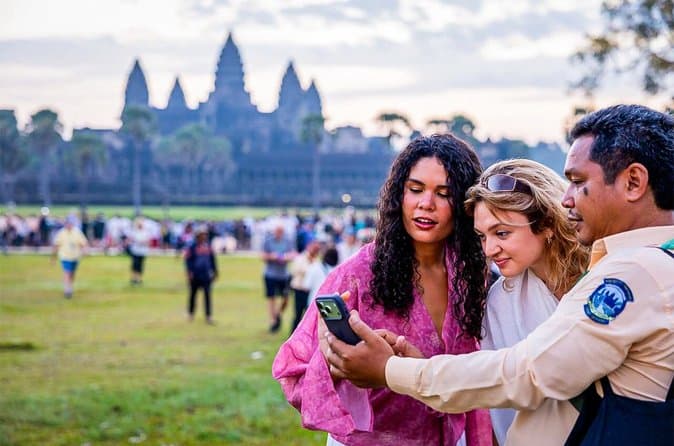
Facts land differently at 5:45am with the towers going pink. The most-booked way to get the full story — sunrise, the reliefs decoded, then Bayon and Ta Prohm — is the classic small-group day with a guide who knows all of the above and a hundred things more:
Planning solo instead? Start with the Angkor Wat listing, the circuit breakdown, and the rest of the temples of Angkor.