Here's the mistake nearly everyone makes: treating Angkor Thom as "the place the Bayon is." It's actually the other way around — Angkor Thom is a nine-square-kilometer walled city, the last and greatest capital of the Khmer Empire, and the Bayon is merely its heart. Built by Jayavarman VII after he drove out the Cham invaders in the late 12th century, the city held a population most medieval European capitals couldn't dream of. Rush it and you've seen a temple; walk it and you've seen a civilization.
Start at the South Gate (Slowly)
The approach is the masterpiece. The causeway over the moat is lined with rows of gods on one side, demons on the other — 54 of each — hauling on the body of a great serpent: the Churning of the Sea of Milk turned into infrastructure, with the whole city as the prize being churned. Above the arch, four giant faces watch the horizon. Arrive right at opening and you'll share it with mist and a few cyclists; by 9am it's a bus park. This five minutes is the best free spectacle at Angkor — do not do it through a windshield. (Photographers: low morning light on the demon row is the shot — angles in our photography guide.)
The Heart: Bayon
At the exact center, where the roads from all five gates meet, stands the Bayon and its two hundred smiling faces. It deserves — and has — its own full guide; the short version is: walk the daily-life bas-reliefs first, save the face towers for when the terraces thin, and give it ninety minutes.
What Everyone Sprints Past
- Baphuon — the massive 11th-century temple-mountain just north of the Bayon, older than the city around it. Its modern story is as good as its ancient one: dismantled into hundreds of thousands of stones for restoration, records destroyed in the civil war, then reassembled over decades — archaeologists called it "the world's largest jigsaw puzzle." The summit view over the treetops is one of the park's best.
- Phimeanakas & the royal enclosure — the palace itself was wood and is long gone, but its pyramid shrine and quiet walled grounds remain, shady and nearly empty.
- The Terrace of the Elephants — a 300-meter royal viewing platform carved with elephant processions, from which kings reviewed armies on the great square. Stand on it and picture the parade ground full.
- The Terrace of the Leper King — behind a false wall, a hidden corridor of carvings as crisp as the day they were cut. Most visitors never find the inner passage; look for the entrance at the terrace's north end.
- The other four gates — the Victory Gate and the quiet North and West Gates see a fraction of the South Gate's traffic. Cyclists can ride the wall itself in places — the city rampart is a raised jungle path with moat views (the bike tour guide explains why two wheels suit this city).
How Long Does Angkor Thom Take?
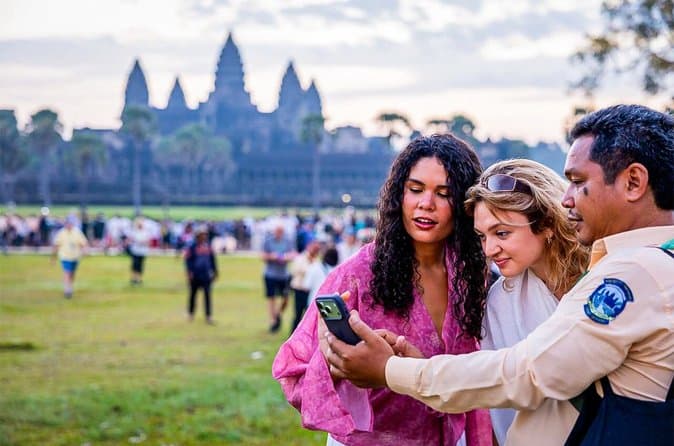
Honest answer: half a day done properly — South Gate, Bayon, Baphuon, the terraces, and a gate or two — which is why the classic Small Circuit day gives it the whole late morning. The standard first-day structure (sunrise at Angkor Wat, then Angkor Thom, then Ta Prohm) exists because it works; the most-reviewed small-group tour runs exactly that routing with the history narrated:
Independent? The city is flat, shaded, and made for wandering between the big stops — the rare place at Angkor where getting slightly lost is the feature. Just carry water, mind the dress code for the Bayon's upper levels, and have your pass ready at the gate. The quick-reference version lives on the Angkor Thom listing, and the must-see temples page maps its place among the icons.