Angkor Wat is the temple you've seen; the Bayon is the one that gets under your skin. Stand on its upper terrace and you're surrounded — dozens of towers, each carved with enormous serene faces gazing out in every direction, smiling the same faint, unknowable smile. There is nothing else like it in the world, and the questions everyone asks standing there — whose face is that, and why so many? — have genuinely fascinating answers.
Whose Face Is It?
The honest scholarly answer: probably two people at once, on purpose. The faces are generally identified as Avalokiteshvara (Lokeshvara), the bodhisattva of compassion — but they also bear a striking resemblance to surviving portrait statues of Jayavarman VII, the king who built the temple around the turn of the 13th century. Most scholars think the ambiguity was the point: a god-king merging his own image with divine compassion, watching over every corner of his empire from the exact center of his capital. When people talk about the "smile of Angkor," this is the smile they mean — and once you've seen it in the flesh, you'll spot echoes of it on carvings across the whole park.
Why the Bayon Is Different from Every Other Temple
The Bayon was the state temple of Angkor Thom, Jayavarman VII's walled capital — and unlike the Hindu temple-mountains that came before it, it was built as a Mahayana Buddhist monument, the crescendo of the empire's great religious pivot. It sits at the precise center of the city, where the roads from all five gates of Angkor Thom converge; the face-towers on those distant gates are the Bayon's outriders. Later kings remodeled it as the state religion swung back toward Hinduism and then to Theravada Buddhism, which is why the temple reads like a palimpsest — images altered, shrines repurposed, layers on layers. That dense, jumbled, slightly chaotic quality is half its magic: where Angkor Wat is a single perfect argument, the Bayon is a conversation that ran for centuries.
Don't Skip the Bas-Reliefs (Everyone Does)
Most visitors climb straight to the faces and miss the temple's other treasure: the outer gallery bas-reliefs, more than a kilometer of carved storytelling that is far more human than anything at Angkor Wat. Here it isn't gods and epics — it's 12th-century daily life: market women haggling, cockfights, a woman giving birth, men playing chess, fish sizzling over a grill. Threaded through it all is the great naval battle against the Cham on the Tonlé Sap, carved with crocodiles picking off the fallen between the war canoes. Walk the east and south galleries slowly before you climb; ten minutes of looking turns the temple from a photo stop into a documentary. (This is also the single strongest argument for a guide anywhere in the park — the reliefs are a library, and a good guide reads them aloud.)
Timing: How to Meet the Faces Alone
The Bayon is on every itinerary, so crowd-timing matters nearly as much as at Ta Prohm:
- 7:30–8:30am: the sweet spot. The sunrise crowd is still inside Angkor Wat; you can have the upper terrace in raking golden light with a handful of people. This is when the faces are at their most alive — low sun gives them shadows, depth, and that famous smile.
- After 3:00pm: the second window, as the tour groups rotate out toward sunset spots. Late light from the west does for the faces what dawn does.
- Avoid 9:00–11:30am, when the terraces are shoulder to shoulder and every face has a person posing nose-to-nose with it (the classic photo — our photography guide shows how to get it without the queue).
The Practical Details
- Where: the exact center of Angkor Thom, on the Small Circuit between Angkor Wat and Ta Prohm — see the circuit guide for how the day fits together.
- Hours: daily 7:30am–5:30pm; standard Angkor Pass required.
- Dress: shoulders and knees covered, like every temple (the rules).
- Time needed: 90 minutes to do both the reliefs and the towers justice.
- Underrated moment: the walk or ride from the South Gate causeway — gods and demons churning the moat — arriving at the Bayon the way the city's builders intended.
Seeing It Right
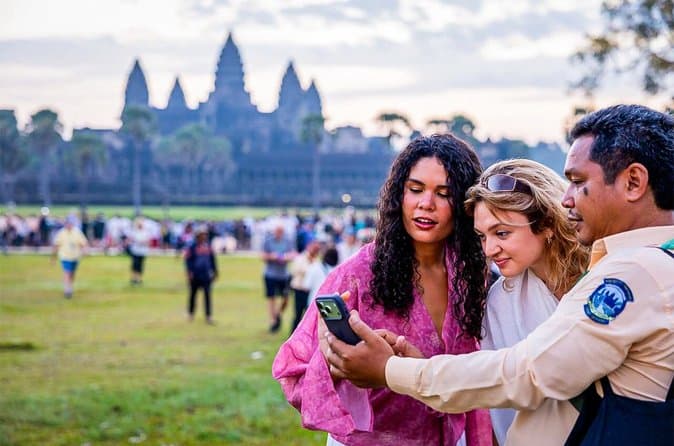
The Bayon anchors the classic first temple day — sunrise at Angkor Wat, then the Bayon while the light is still low, then Ta Prohm. The most-reviewed small-group tour in Siem Reap runs exactly that sequence, with a guide to read the reliefs and the routing to dodge the mid-morning crush:
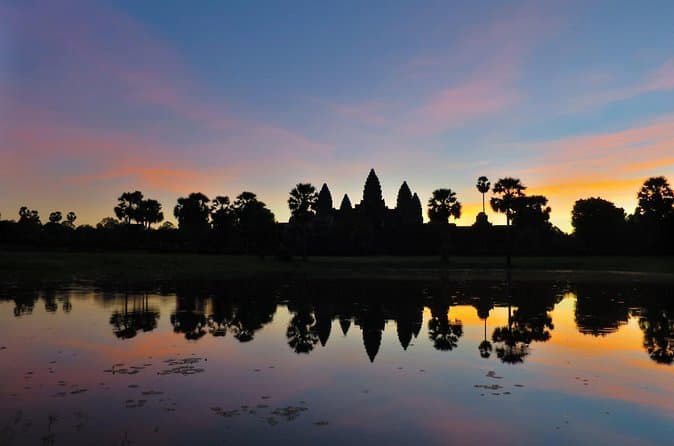
Prefer a slightly different shape to the day? This highlights version pairs the same sunrise-and-Bayon core with a compact itinerary:
And if you're doing it independently, it's an easy stop on any tuk-tuk day — just get there before nine, walk the reliefs first, and save the faces for when the terrace empties. Then look up, pick one tower, and hold its gaze for a minute. Eight hundred years on, the Bayon still wins the staring contest. More on the temple itself on our Bayon listing, and the rest of the icons in must-see temples.