Banteay Srei breaks every rule of Angkor. It's small where the others are vast, pink where they're grey, intimate where they're imperial — and it carries carving so deep and precise that early archaeologists refused to believe stone-workers had done it without magic. If Angkor Wat is the empire's greatest building, this little temple 37 km north of it is the empire's greatest craftsmanship. Here's what you're actually looking at.
The Temple a King Didn't Build
Almost every major Angkor monument is a royal project. Banteay Srei is the exception: consecrated in 967 AD and dedicated to Shiva, it was built not by a king but by Yajnavaraha, a Brahmin scholar and counselor to King Rajendravarman and tutor to the future Jayavarman V. That's why it feels different — a temple built by a scholar-priest at a courtly scale, out in the countryside, refined rather than overwhelming. Its original name was Tribhuvanamaheshvara, "Great Lord of the Threefold World"; the modern name Banteay Srei — usually rendered "Citadel of Women" or "Citadel of Beauty" — came centuries later, from the local conviction that carving this delicate must have been done by women's hands.
Why It's Pink (and Why the Carving Survived)
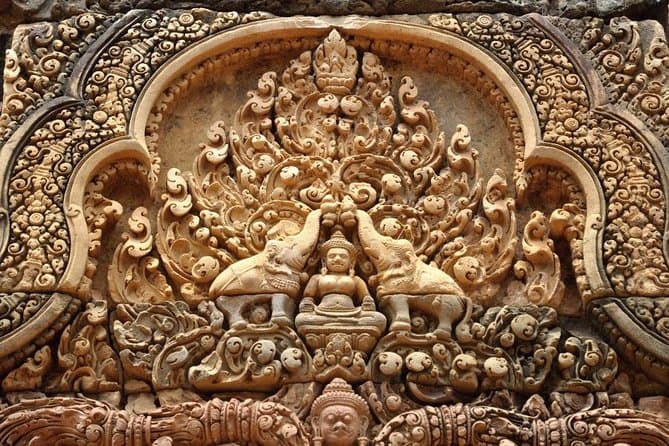
The temple is built of hard red sandstone that blushes pink to rose-gold depending on the light. That hardness is the secret: it takes fine detail like wood and holds it for a thousand years, which is why Banteay Srei's decoration is still crisp while softer stone elsewhere has melted into suggestion. Nearly every surface is worked — lintels, pediments, pilasters, false doors — with a density the big temples never attempt.
What to Look For
- The pediments — the triangular panels above doorways are the masterpieces, telling Hindu stories in deep, almost three-dimensional relief. The most famous shows the demon king Ravana shaking Mount Kailasa while Shiva sits unmoved on its summit — find it and give it five full minutes.
- The devatas — serene female divinities in niches, jewelry and drapery carved to the millimeter. (The ones in place today at certain spots are replicas; several originals live in museums — see the story below.)
- The kala heads — the bulging-eyed guardian faces devouring garlands over the doorways, sharper here than anywhere in the empire.
- The miniature scale — the sanctuary doorways are barely shoulder height. You don't walk into Banteay Srei so much as lean into it, which is exactly why it photographs like a jewel box.
The central sanctuary is roped off to protect it, so the visit is a slow circuit of the enclosures — bring your longest attention span rather than your widest lens (angles and light in our photography guide).
The Best Story at Angkor: The Malraux Affair
In 1923, a young Frenchman arrived at the then-barely-documented temple, sawed several of its finest devatas from the walls, and was arrested in Phnom Penh trying to ship them out. His name was André Malraux — later one of France's most celebrated writers and, remarkably, eventually its Minister of Culture. The sculptures were recovered, the scandal helped push colonial authorities to properly protect Angkor, and Banteay Srei became the site of the park's first great scientific restoration in the 1930s, rebuilt stone by stone using the anastylosis method. The temple you walk through today is both a 10th-century masterpiece and the birthplace of modern conservation at Angkor.
Timing Your Visit
The stone performs on a schedule. Early morning (the site opens at 5:00am, well before the tour buses arrive around mid-morning) gives you soft pink light and near-solitude; late afternoon turns the sandstone rose-gold. Midday flattens the relief and fills the small enclosures with groups — and small is the operative word: fifty people here feels like five hundred at the Bayon. The site itself needs only about an hour, which is why it pairs so naturally with the Cambodia Landmine Museum down the road and a slow drive through the sugar-palm countryside.
The Practical Details
- Where: ~37 km north of Siem Reap — a dedicated trip, not a circuit stop. Roughly 45 minutes to an hour by car, longer by tuk-tuk.
- Tickets: covered by the standard Angkor Pass — checked at the site like everywhere.
- Hours: daily 5:00am–5:00pm (note the earlier close than the main circuits).
- Dress: shoulders and knees covered (the rules).
- Time on site: ~1 hour; budget a half day with travel.
Getting There
Full route logistics — tuk-tuk vs car costs, what to pair it with, countryside stops — live in our Banteay Srei day trip guide. The booked-and-done version is the dedicated day tour, which handles the distance and adds the context that makes the carvings speak:
Folding it into a bigger temple plan instead? The two-day circuits-plus-Banteay-Srei structure covers the icons and this one properly:
However you arrive, go early, stand in front of the Kailasa pediment, and remember it was cut by hand a thousand years ago in stone chosen because it would hold every line until you got there. Then see how it compares with the rest of the outer temples — and the temple's own listing has the quick-reference version.