Every driver and tour menu in Siem Reap offers two loops through Angkor: the Small Circuit and the Grand Circuit (locals say "big circuit" — same thing). The names describe road distance, not importance, and choosing between them badly is the easiest way to waste a temple day. Here's the actual difference.
The Small Circuit: The Icons
The Small Circuit is the greatest-hits loop, and it earns the billing. One full day covers:
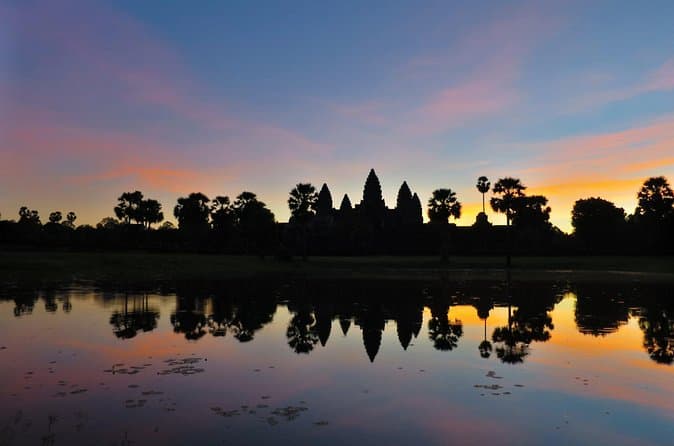
- Angkor Wat — the main event, ideally at sunrise (our sunrise guide has the minute-by-minute plan).
- Angkor Thom and Bayon — the walled royal city and its temple of 200 stone faces.
- Ta Prohm — the tree-strangled "Tomb Raider" ruin.
Time: one long day. With a sunrise start you'll be done by mid-afternoon, conveniently before the worst heat. Crowds: heavy — these are the three most famous temples in Cambodia, and every first-timer is on this loop with you. Routing matters more than anything: go against the bus flow and the same temples feel half as busy.
The Grand Circuit: The Atmosphere
The Grand Circuit swings wider and quieter through the park's northern reaches:
- Preah Khan — a vast, half-restored monastic complex that rivals Ta Prohm for jungle drama with a tenth of the crowd. The loop's headliner.
- Neak Pean — a tiny island shrine reached by a boardwalk across a reservoir. Strange, serene, and over in twenty minutes.
- Pre Rup — a steep brick pyramid that turns molten at golden hour.
Time: a comfortable day, with slack for long lunches or extra stops. Crowds: noticeably thinner. The Grand Circuit is where Angkor stops feeling like an attraction and starts feeling like a discovery — fans of that mood should also see our hidden gems picks.
Which Order? Small First. Almost Always.
Do the Small Circuit on Day 1, Grand Circuit on Day 2. Two reasons. First, if anything cuts your trip short, you've seen the icons. Second, the Grand Circuit is better with context — Preah Khan lands harder once you've seen what restored Angkor looks like. The exception: photographers chasing solitude sometimes flip the order to learn the light on quiet temples first. Note that Banteay Srei is on neither loop — it's a separate ~37 km trip north that pairs with the Cambodia Landmine Museum, usually bolted onto the Grand Circuit day.
The cleanest way to get all of it — both circuits plus Banteay Srei, correctly sequenced across two days — is a single two-day booking:

Who Should Pick Which
- One day only: Small Circuit, no contest. A 1-day Angkor Pass is $37; start at sunrise.
- Two or three days: both circuits on a $62 three-day pass — the days don't need to be consecutive, which our Angkor Pass explainer covers in detail.
- Crowd-averse or repeat visitors: weight your time toward the Grand Circuit and the outer temples.
- Families: Small Circuit highlights in one morning beats two dutiful days; kids hit temple fatigue fast.
If you can only spare a single day but refuse to skip sunrise, a highlights-and-sunrise day tour compresses the Small Circuit's best into one well-routed run:
Sunset Spots, by Circuit
Small Circuit days: Phnom Bakheng is the classic hilltop sunset over Angkor Wat — but the summit is capped at 300 people, so arrive by 4:30pm or you're watching from the path. Shoulders and knees covered; it's enforced up top. Grand Circuit days: Pre Rup is the smarter play — west-facing brick, warm light, and no quota drama. Honestly, it's the better photo most evenings.
Practicalities
A tuk-tuk runs about $20–35 per day and handles either loop easily; a car with driver ($40–60) earns its keep in March–May heat or green-season downpours. A licensed guide ($35–50/day) transforms Bayon and Preah Khan from piles of stones into stories — worth it for at least one of your two days. Build the loops into a full trip with our 3-day itinerary, and browse every temple we cover in the temples category.