Checked 26 October 2026. Sambor Prei Kuk is the temple zone of Ishanapura, a Chenla capital from the late 6th and early 7th centuries, and a UNESCO World Heritage Site since 2017. It is not an Angkor temple that happens to be far away. The art style here is what later Angkor builds on. The day from Siem Reap is a long drive south through Kampong Thom, a morning among brick towers, and the same road back.
Why it matters
UNESCO’s listing is titled Temple Zone of Sambor Prei Kuk, Archaeological Site of Ancient Ishanapura. The short description identifies the site as Ishanapura, capital of the Chenla Empire in the late 6th and early 7th centuries, and says the property holds more than a hundred temples, ten of them octagonal, a form it calls unique in Southeast Asia. The name means “the temple in the richness of the forest.”
The statement of outstanding value on the same page goes further: a temple zone of 840 hectares east of a moated city, an ensemble of 186 fired-brick temples with sandstone lintels and pediments, and the Sambor Prei Kuk style as the foundation of later Khmer architecture. Inscriptions in Sanskrit and old Khmer are part of why it is inscribed. The inscribed property is given as 840.03 hectares, with a buffer of about 2,524 hectares. Date of inscription: 2017.
The octagon count is not identical in those two UNESCO texts. The short description says ten. The longer statement says eleven. This guide does not pick a winner. What you will see is brick towers, some of them octagonal, with sandstone doors and lintels in a style that is plainly older than Angkor Wat. The Khmer Empire history starts in 802, on Phnom Kulen. Sambor Prei Kuk is the capital before that story.
The three groups
UNESCO names three main complexes:
- Prasat Sambor, the northern group, including the Prasat Sandan and Prasat Bos Ream groups in the fuller text. Three enclosure walls, the outer one described as extending to 389 metres.
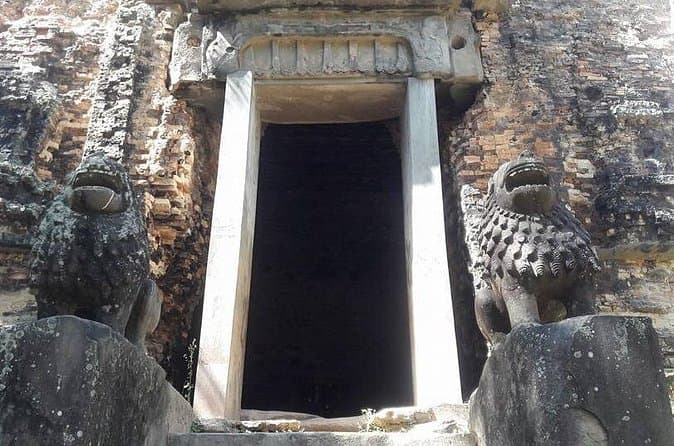
- Prasat Tao, the central group, the one associated with the lion sculptures that give it the name “tao.”
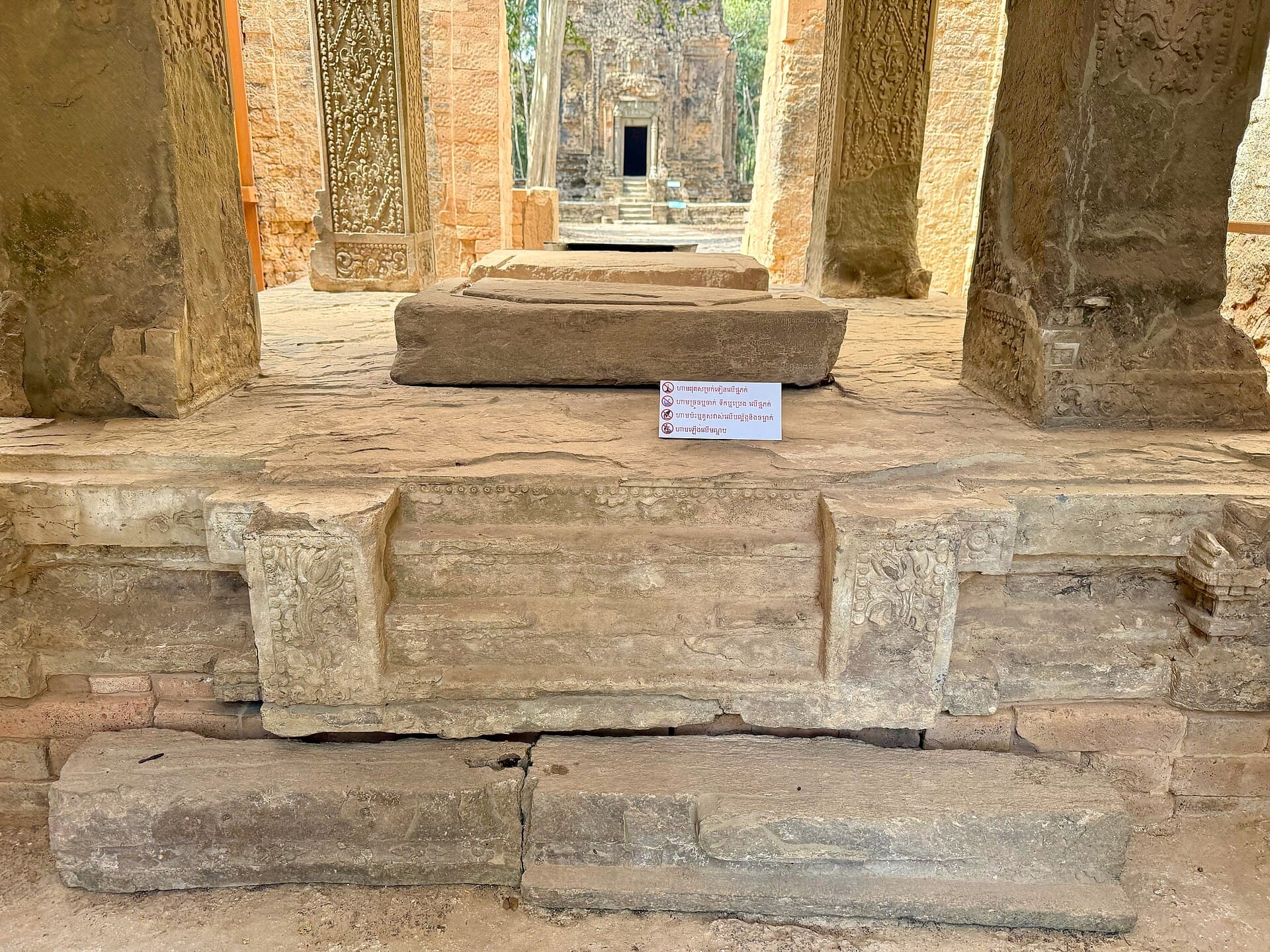
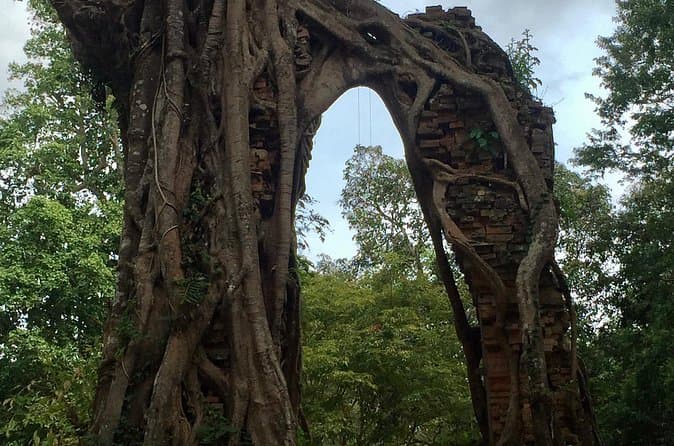
- Prasat Yeai, the southern group, also called Yeay Poeun. The photograph on this page is that group.
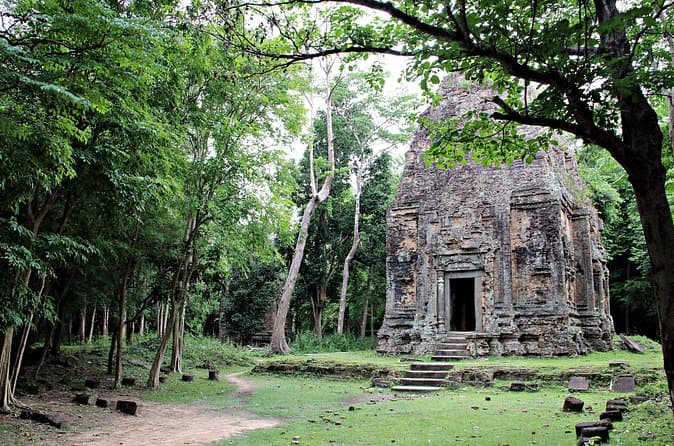
Each has a central tower on a raised platform, smaller towers, and a brick or laterite wall. The longer UNESCO text says six of the octagonal temples carry sculpted flying palaces. Look for those on the outer walls: miniature buildings in relief, as if a shrine were wearing other shrines. Sandstone lintels and colonnades are the pieces the short description calls masterpieces. Many of the finest free-standing statues are in museums, which UNESCO notes directly. You are looking at architecture and the carving that stayed on the building.
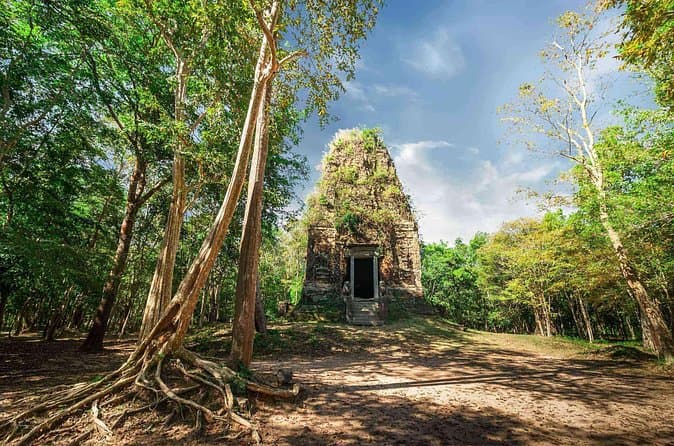
Trees still grow through some of the brick. Which tower is the dramatic one changes as conservation proceeds, so this guide does not nominate a single tree-tower. If a path is closed around a tower, it is closed. The National Authority for Sambor Prei Kuk manages the site under a royal decree of 24 December 2014, according to the UNESCO listing.
Getting there
Hire a car and a driver. This is highway driving, not a park loop. OpenStreetMap routing on 26 October 2026 puts the Old Market to the site at about 168 km and a model time near 2 hours 10 minutes. That model is optimistic on a Cambodian national road. Plan 2.5 to 3.5 hours each way, leave around 7:00, and keep the afternoon for the temples rather than for a third province.
The road runs south to Stueng Saen, the town of Kampong Thom province, about 148 km, and then about 30 km on to the temples. A food stop in town is the natural break. A tuk-tuk is the wrong tool. Our tuk-tuk guide tops out at Banteay Srei distances. Budget the car as a longer hire than an Angkor temple day, and agree the price before you leave. We are not printing a dollar figure for this route.
The same highway is the road to Phnom Penh. If that city is your next stop, Sambor Prei Kuk is a better use of the day than a there-and-back. The Siem Reap to Phnom Penh guide has the bus and the flight. The car is the option that can stop.
Tickets and hours
We could not open a ministry page that states the current entrance fee and the opening hours. On 26 October 2026 one Viator product for this site listed “entrance fee is $10 per person” under exclusions. Another product includes admission. Both can be true of those bookings and still fail as a tariff. Carry small notes. Ask at the gate. If a local guide is offered there, that is the person who knows which towers are open this month.
UNESCO records a local organisation, the Conservation and Development Community for Sambor Prei Kuk, set up in 2004 with the agreement of the Ministry of Culture and Fine Arts, working with the site authority on conservation and community engagement. We could not confirm a current official community-guide fee schedule. Pay the person you hire, at a price you agreed before the walk.
What the day feels like
You will be nearly alone by Angkor standards. The towers are brick, red, and lower than a gallery at Angkor Wat. The interest is the octagons, the flying palaces, the lintels, and the fact that this was a capital when Angkor was still in the future. Give the three groups a morning. Shade is limited. Water, a hat, and the usual shoulders and knees apply. The packing list is the same list as for the park, plus more water because the drive is longer.
Tours, after the car
A driver and a site guide is the trip. The products below are the booked version of that day, useful if you want lunch, the entrance, or a Tonlé Sap stop written into the price. Read inclusions. We are not repeating operator histories from those listings: the site is brick and sandstone Chenla architecture, and the UNESCO page is the history. One product also visits the lake, which makes an already long day longer. Choose it when the lake is the second half you wanted, not as a surprise.
Sambor Prei Kuk, Koh Ker, or Beng Mealea
Three different days.
- Koh Ker is a 10th-century Angkorian capital with a pyramid, about 108 km northeast, plan about two hours. It has its own pass product on Angkor Enterprise’s ticket list.
- Beng Mealea is a jungle temple east of Siem Reap, about 53 km, about an hour. Closer, and still a full morning.
- Sambor Prei Kuk is older than both, further, and quieter. Choose it when the pre-Angkor brick is the thing you came to see, or when you are already driving to Phnom Penh.
The day trips guide and the temples map show the directions. With three days in Siem Reap, the circuits and Banteay Srei come first. Sambor Prei Kuk fits a longer stay, or the transfer day south.
FAQ
Is Sambor Prei Kuk worth a day from Siem Reap?
Yes if you have already seen the main Angkor circuits and you want a pre-Angkor city rather than another Angkorian temple. UNESCO inscribed it in 2017 as Ishanapura, the Chenla capital of the late 6th and early 7th centuries. The drive is the cost: about 168 km from the Old Market, commonly planned as 2.5 to 3.5 hours each way. On a two-day Siem Reap trip, stay in the park.
How do I get to Sambor Prei Kuk from Siem Reap?
By car with a driver, on the highway south through Kampong Thom (Stueng Saen) and then about 30 km east to the site. OpenStreetMap routing puts Siem Reap to Stueng Saen at about 148 km and Stueng Saen to the temples at about 30 km. A tuk-tuk is the wrong vehicle for this road. The same highway continues to Phnom Penh, so the site can also be a stop on that transfer rather than a there-and-back day.
What does Sambor Prei Kuk cost?
We could not find a ministry tariff page we could quote on 26 October 2026. One private tour on Viator lists an entrance fee of $10 per person as excluded. Another includes admission. Those are booking terms, not an official price. Ask your driver what the gate charged on their last trip, and carry small US dollars so you can pay whatever the window asks.
What are the three temple groups?
UNESCO’s statement of outstanding value names three complexes: Prasat Sambor (northern group), Prasat Tao (central group) and Prasat Yeai (southern group, also called Yeay Poeun). Each has a central brick tower and smaller towers inside a walled enclosure. The public description says more than a hundred temples, ten of them octagonal. The longer statement says 186 fired-brick temples and eleven octagonal towers. Both sentences are on the UNESCO listing.
Can I combine Sambor Prei Kuk with Koh Ker or Beng Mealea?
Not usefully, on one day from Siem Reap. Koh Ker is northeast, about 108 km from town. Beng Mealea is east, about 53 km. Sambor Prei Kuk is south, past Kampong Thom. They share a theme, older or quieter stone, and they do not share a road. Pick one outlier day.
History and the three group names are from UNESCO’s listing for site 1532, read 26 October 2026. Distances are OpenStreetMap routing from the same day. The entrance fee is not an official figure until you see it at the gate.