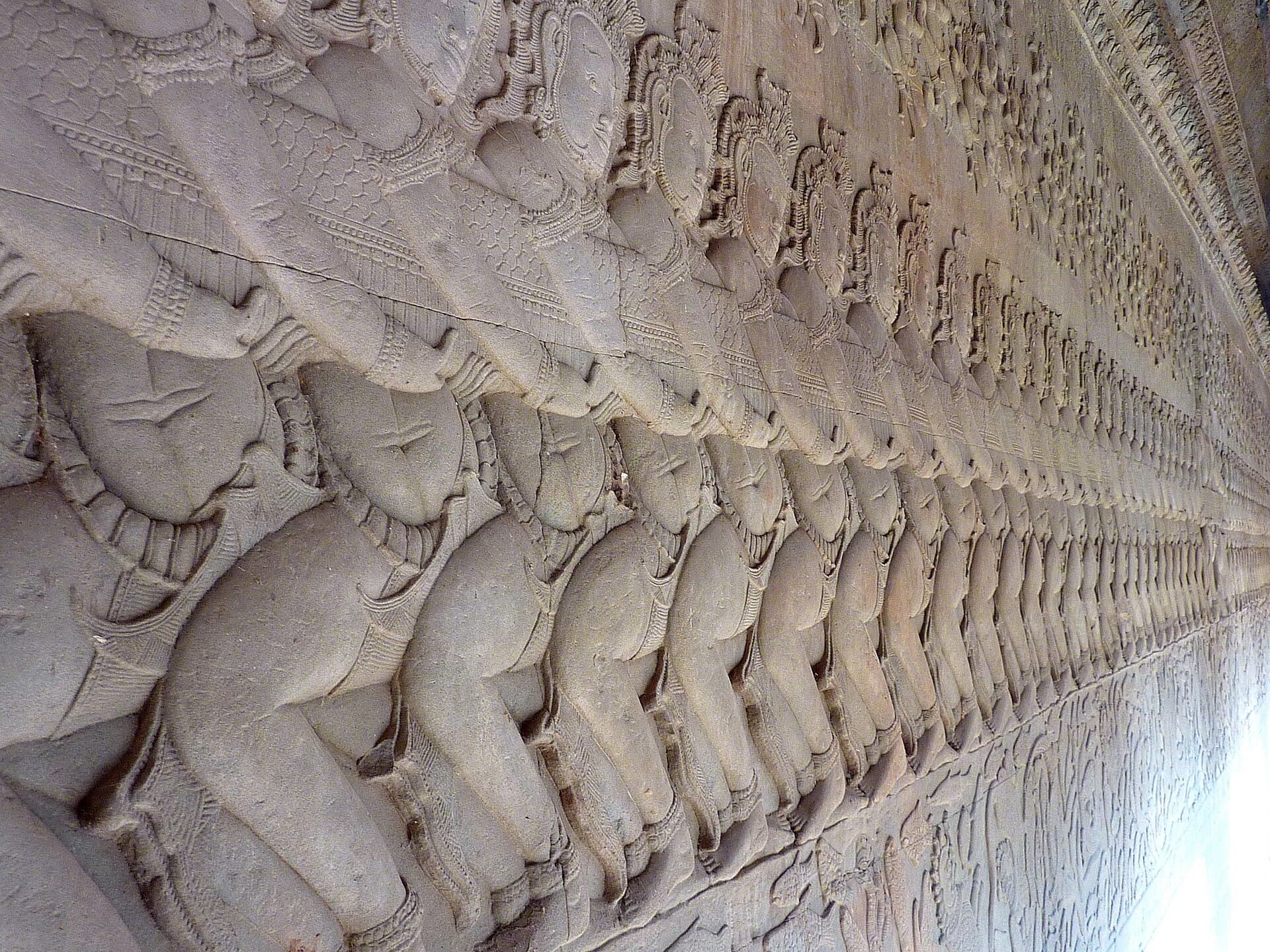
The bas-reliefs are the outer gallery of Angkor Wat, a covered stone book that runs around the third enclosure. This page is the reading order. The building as a whole is the visiting guide. Dates, kings and measurements of the temple are the facts page. Gates and tickets are a single link: the opening hours and the Angkor pass.
The panel names below follow the long-standard reading in Maurice Glaize, The Monuments of the Angkor Group, and the gallery plan published by Dawn Rooney and reused in later studies. If a conservator has a gallery roped off, the order changes for that morning.
How the galleries work
Stand at the west entrance, the way you came in across the causeway. The gallery runs left and right. The visitor route that matches the way the stories are usually taught turns left, toward the south, and keeps the central sanctuary on the left. Glaize identifies that direction as prasavya, the reverse of pradakshina, the clockwise circuit that keeps a shrine on the right. He reads the reversal as part of the temple’s west-facing, Vishnuite character. You do not have to settle that argument to see the carvings. Walk counter-clockwise if you want the list below to arrive in order. Walk the other way if a crowd has claimed the south wall. The eight long panels are two to a side.
How long is the circuit? Published figures disagree. One guide to the galleries says more than 600 metres including the western corner pavilions. A study of the same reliefs says the eight great panels run more than 500 metres and about 1,200 square metres, inside a temple that holds still more carved surface. You will also see “800 metres” and “nearly a kilometre.” We did not remeasure, and we did not find a single length on an Angkor Enterprise or UNESCO page we could open. Budget the time, not the metre count: about 60 minutes for the eight panels, about 90 minutes with the corner pavilions.
Devatas and apsaras cover the walls outside these narrative galleries. Counts in print vary. This page does not give a total.
West gallery
South wing: the Battle of Kurukshetra
The Mahabharata’s last battle. Two family armies, the Pandavas and the Kauravas, fill the wall. Krishna drives Arjuna’s chariot. It is the first panel if you turned left from the west door. The soldiers are dressed as a 12th-century Khmer army, which is the point: the myth is told in the sculptors’ own present.
North wing: the Battle of Lanka
The Ramayana. Rama’s monkey army against Ravana. You reach it at the end of a counter-clockwise circuit, or first if you turned right. Hanuman is in the fight. The monkeys are carved with human bodies and monkey faces. It is the panel people recognise once someone has said “Lanka” out loud.
South gallery
West wing: Suryavarman II and his army
Glaize calls this the historical gallery, a single panel he gives as 90 metres, dedicated to Suryavarman II, the king who built Angkor Wat. He sits larger than the men around him, reviewing troops, commanders, and a forest of spears. This is the one panel that shows a historical king rather than a myth. The gilding on the king is later.
East wing: heaven and hell
Yama judges the dead. The upper registers are heaven. The lower registers are hell, with punishments specific enough that you will not need a caption to know which is which. It is the panel children remember, and the one to see before you are too hot to look down.
East gallery: the Churning of the Ocean of Milk
The southern half of the east wall is the churning. Gods and demons use the serpent Vasuki as a rope and Mount Mandara as a pivot, spinning the ocean to bring up the elixir of immortality. Vishnu is in the centre. Apsaras rise out of the water. The Phnom Penh Post, reporting the World Monuments Fund’s completion announcement on 11 January 2013, called the relief 49 metres long. An English edition of the older Wondrous Angkor guide calls the same panel 162 feet, which is the same length.
The World Monuments Fund, working with APSARA, finished a major conservation of this gallery in January 2013. The Post reported that the study began in the early 2000s, that a formal project was presented in 2008, and that the work included dismantling the roof so water would stop running through the carving. In January 2024 the Fund transferred day-to-day care of the gallery, together with Ta Som and Preah Khan, to APSARA. The carving you see is the original relief, conserved, not a cast.
The northern half of the east gallery is a separate scene in the Rooney plan: Vishnu’s victory over the asuras. Do not stop at the churning and assume the rest of the east wall is the same story.
North gallery
The north wall is the section many people skip, and part of it is later work. The Rooney plan marks, on the east wing, Krishna’s victory over the asura Bana, and on the west wing a battle of gods and demons. A published study of the galleries says these north-eastern reliefs were carved in the mid-16th century, long after Suryavarman II, and that the cutting is rougher. We are passing that on as a published reading. The difference is visible when you have just left the churning: the line is less sure, the storey is still a divine war.
The corner pavilions
Four corner pavilions break the long walls into rooms of smaller reliefs. The Rooney plan marks Ramayana scenes in those pavilions, alongside Krishna episodes. They reward a guide with a pointer more than they reward a hurried lap. If you have the extra half hour, do the southwest pavilion after Kurukshetra and the southeast pavilion before heaven and hell. If you have an hour total, stay on the eight long panels and leave the corners.
A 60-minute route, and a 90-minute route
Sixty minutes. Enter from the west, turn south. Kurukshetra, Suryavarman’s army, heaven and hell, the churning, Vishnu and the asuras, Krishna and Bana, the gods and demons, Lanka. Then leave the gallery and decide whether you still have legs for the upper levels. The visiting guide’s route does the reliefs before the Bakan queue, which is the right order on a hot day.
Ninety minutes. The same circuit, plus one corner pavilion on the south side and a slower pass on the churning. Sit on the gallery ledge only where sitting is obviously allowed. Do not lean on the carved surface. Oil from hands is how a shallow relief goes bald. The etiquette guide is the dress half of the same rule.
An hour at the Angkor National Museum the day before makes the churning recognisable when you are standing in front of it. The museum’s gallery of gods is the glossary. The temple is the book.
A guide, or this page
For the reliefs, a guide earns the fee in a way they do not earn it in an empty courtyard. The products below are temple days with a guide, which is what you want if this gallery is the reason you came. Going alone, keep this order on your phone and accept that you will miss names.
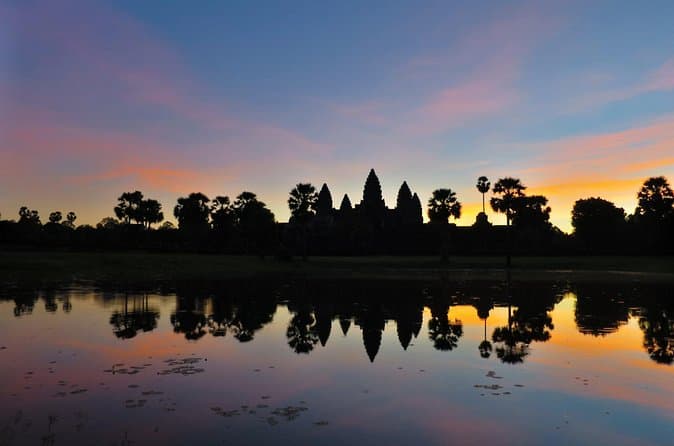
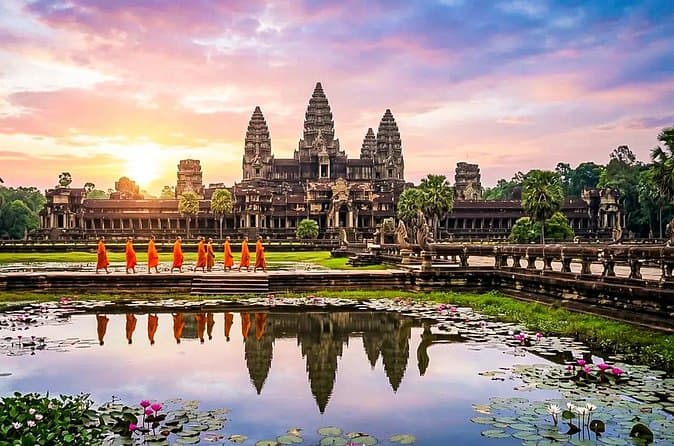
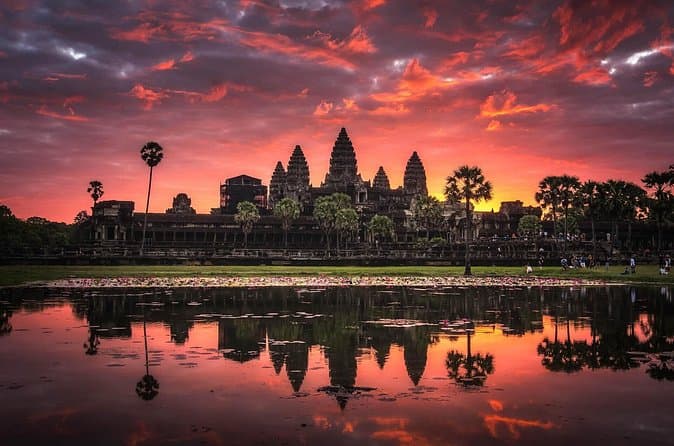
The pass is separate. The DIY guide is the version where you hire the tuk-tuk and carry the names yourself. Photography of the galleries is allowed; flash and tripods are the usual problem in a narrow corridor. The photography guide covers light. Morning side-light on the west gallery and afternoon light on the east are the two reasons to walk the circuit twice if your pass lets you back in.
FAQ
Which way do you walk the Angkor Wat bas-reliefs?
Visitors usually walk the third-enclosure gallery counter-clockwise, starting from the west entrance and turning south. Maurice Glaize describes that direction as prasavya, the reverse of the clockwise pradakshina that keeps a monument on the right. The panels below are listed in that counter-clockwise order. You can walk clockwise. The labels are the same either way. If a rope closes a section, follow the open gallery and pick the story up on the next wall.
Where is the Churning of the Ocean of Milk?
On the east gallery. In the standard reading it occupies the southern half of that wall. A Phnom Penh Post report of the 2013 restoration called the panel 49 metres long. Walk to the far side of the temple from the west entrance, keeping the sanctuary on your left, and you meet it after the south gallery.
How long do the bas-reliefs take?
About an hour for the eight long panels if you stop at each one, and about ninety minutes if you add the corner pavilions. That is a planning range, not an official timed route. Published lengths for the whole circuit disagree (figures over 500 metres and over 600 metres both circulate). We did not remeasure the galleries.
Are the bas-reliefs Hindu or Buddhist?
The narratives are Hindu: the Mahabharata, the Ramayana, the churning myth, and Vishnu and Krishna fighting asuras, plus a historical panel of Suryavarman II and his army. Angkor Wat was built as a Vishnu temple and later became a Buddhist sanctuary, which it still is. The gallery is the Hindu library. The worship in the central shrine is Buddhist.
Is a guide worth it for the bas-reliefs?
For this gallery, yes, more than for any other hour in the park. The carvings are a text. Without the names you will still see a battle. With them you will see which battle. A guidebook page on your phone works if you already know the order below. Do not touch the stone either way.
Panel names follow Glaize and the Rooney gallery plan. The 49-metre figure and the 2013 completion date are from the Phnom Penh Post’s report of 11 January 2013. The 2024 handover is from the Post and from ArtDependence’s report of the World Monuments Fund transfer. We did not remeasure the walls.