It's the great Southeast Asia dilemma: Cambodia's Angkor or Myanmar's Bagan? Both are vast ancient temple landscapes, both promise transcendent sunrises, and both anchor entire trips. We run a Siem Reap site, so you know where our hearts live — but this comparison plays it straight, because the two places are genuinely different experiences solving different dreams.
The Fundamental Difference
Angkor is depth; Bagan is breadth. Angkor's genius is concentrated in individual masterpieces — the perfect geometry of Angkor Wat, the two hundred faces of the Bayon, the carving of Banteay Srei — monuments you enter and read for hours. Bagan's genius is the plain itself: thousands of brick stupas scattered across a river bend, a skyline of temples to every horizon, best absorbed as a panorama at dawn. Crudely: Angkor is a museum of masterpieces; Bagan is a landscape painting. Which sentence made your pulse move? That's your answer.
Head to Head
The monuments themselves
Angkor, and it isn't close. The Khmer built in sandstone at cathedral scale with kilometer-long bas-reliefs; Bagan's brick shrines are atmospheric in aggregate but few reward an hour inside. If architecture, carving, and "how did humans build this" are your fuel, Angkor wins decisively.
The landscape moment
Bagan. Nothing at Angkor matches a Bagan dawn with pagodas to every horizon. Angkor's sunrise is a single perfect silhouette (and we've optimized every minute of it); Bagan's is a whole world waking up.
Logistics & infrastructure
Siem Reap, comfortably: direct international connections, a deep hotel scene at every budget (exhibit A), reliable operators, and tourism infrastructure refined over decades. Myanmar's situation has been volatile for years — check current travel advisories seriously before planning; that alone decides the question for many travelers right now.
Food & the town
Siem Reap again — a legitimate food destination (the evidence), plus Phare, markets, and a town that's a pleasure between temple days.
Crowds
Bagan generally runs quieter — partly geography, partly circumstance. But Angkor's crowds are a solved problem if you follow timing discipline: our deep dives exist precisely to put you in great temples nearly alone.
Cost
Broadly similar daily budgets by style; Angkor's $62 three-day pass is the bigger single ticket, but Cambodia's on-the-ground costs stay friendly (the math).
The Verdict Nobody Wants
If you can only do one right now: Angkor — for the monuments, the reliability, and a town that carries the trip. If you're building a life list: both, separately — they don't substitute for each other any more than Rome substitutes for the Serengeti. And if Bagan's situation stabilizes and you've already done Angkor, go; the plain at dawn will not disappoint you.
If Angkor Wins Your Coin Flip
Start with the 3-day itinerary, book the flagship sunrise day before it sells out, and let the rest of this site do its job:
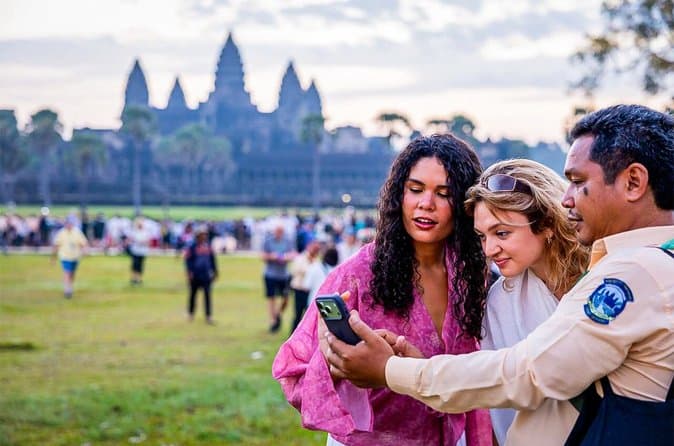
And for the Bagan-hearted who choose Angkor anyway: your consolation prizes are the temple-strewn quiet of the Grand Circuit, the 9th-century Roluos group, and unrestored Beng Mealea — the closest Angkor comes to Bagan's raw-landscape feeling.